Why 'Topping' Your Tree Is Actually Slowly Killing It
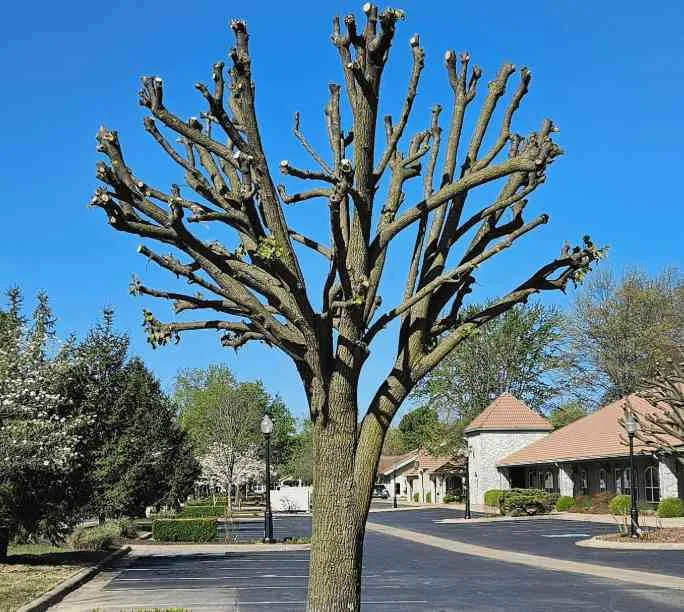
Photo: tree topping damage stubby branches urban yard, via theprecisiontree.com
You've probably seen it around the neighborhood—a once-tall cottonwood or spruce that's been cut down to a stubby collection of thick, blunt branches. Maybe you've even had it done to your own trees. The goal is usually innocent enough: the tree was getting too big, too close to the roofline, or blocking a mountain view. So someone called up a crew, they cut the top off, and now everything looks... manageable.
Except it isn't. What looks like a size reduction is actually the beginning of a slow decline that can take years to fully play out—and by the time homeowners notice the real damage, the tree is often beyond saving.
At Boulder Tree Service, we see topped trees constantly. And every time, we have the same conversation: this didn't have to happen.
What Tree Topping Actually Does to a Tree
Topping—also called hat-racking, heading, or rounding over—involves cutting off the main upright stems or large lateral branches at arbitrary points, usually to reduce the tree's overall height. It's not the same as proper pruning. Not even close.
When a tree is topped, it suddenly loses a massive portion of its leaf-bearing canopy. Leaves are how trees feed themselves through photosynthesis. Strip away 50 to 75 percent of that capacity in a single afternoon, and the tree goes into survival mode. It responds by sending out clusters of fast-growing, weakly attached shoots called epicormic sprouts—sometimes called water sprouts—from just below the cut sites. These grow fast because the tree is desperately trying to restore its ability to make food.
Here's the problem: those new shoots are attached to the outer layer of the trunk, not deeply embedded in the wood the way a natural branch would be. As they grow heavier over the years, they become increasingly prone to breaking—especially during Boulder's intense summer thunderstorms or heavy spring snow loads. You've actually made the tree more dangerous, not less.
And that's before we even get to the rot.
Open Wounds and the Decay Problem
A tree that's pruned correctly—at the branch collar, using proper cuts—can seal over the wound relatively efficiently. But when you lop off a major limb or trunk section in the middle, you're leaving an enormous wound that the tree has no biological mechanism to properly close. The exposed wood becomes an open invitation for fungi, bacteria, and insects.
In Boulder's climate, where we swing between dry summers and wet springs, decay can move quickly through the interior of a topped tree. What looks solid from the outside can be hollow and compromised inside. That's a serious liability when you're talking about a large tree near your house, driveway, or kids' play area.
Certified arborists have a phrase for it: topping creates hazard trees. The irony is that most people top trees because they're worried about safety. The treatment ends up being worse than the original concern.
The Misconceptions That Keep This Practice Alive
So why does topping persist? A few reasons.
First, it looks effective in the short term. The tree is shorter. Problem solved, right? But within a couple of growing seasons, those epicormic sprouts have often returned the tree to its original height—or close to it—while leaving it structurally weaker than before.
Second, some tree services still offer it. Not everyone who shows up with a chainsaw is a certified arborist. If you're getting quotes for tree work in Boulder, always ask whether the company employs ISA-certified arborists. A legitimate professional won't recommend topping as a maintenance strategy.
Third, there's a persistent belief that trees are resilient enough to bounce back from anything. Some are, to a degree. But stress compounds. A topped tree that's also dealing with drought, soil compaction, or pest pressure is fighting on multiple fronts at once. Boulder's urban trees already face enough challenges without adding this one.
What You Can Do Instead
The good news is that there are real, effective alternatives to topping that don't leave your tree damaged and dangerous.
Crown reduction is the professional approach to making a tree smaller. Instead of cutting branches at random points, an arborist removes them back to lateral branches that are large enough to take over as the new growing tip. The tree maintains its natural shape, keeps its structural integrity, and the size reduction actually holds over time. It takes more skill than topping—and yes, it typically costs more—but the results are worth it.
Crown thinning doesn't reduce height so much as it opens up the canopy, removing select branches to improve light penetration and air circulation. This is often what people actually need when they think they need a size reduction. A dense, heavy canopy can be thinned significantly without changing the tree's overall silhouette.
Directional pruning can guide a tree's growth away from structures over time when started early enough. If you've got a young tree that's heading toward your roofline, consistent directional work can reshape its trajectory without drastic intervention.
And sometimes, honestly, the right answer is removal and replanting with a species that fits the space. Planting a silver maple 10 feet from your house was always going to end in conflict. Getting ahead of that with a more appropriately sized species—one chosen with Boulder's elevation and soil in mind—is a smarter long-term investment.
What to Do If Your Tree Has Already Been Topped
If you're looking at a previously topped tree in your yard and wondering whether it's salvageable, the answer depends on a few things: how long ago it was topped, how much of the canopy was removed, and how the tree has responded since.
Some trees can be rehabilitated through a process called restoration pruning—a multi-year effort to selectively remove the weakest epicormic sprouts while encouraging better-structured ones to develop. It won't undo all the damage, but it can significantly improve the tree's long-term prognosis.
Other trees, especially those that have been topped multiple times or have significant internal decay, may be too far gone. A hazard assessment from a certified arborist can tell you where yours falls on that spectrum.
Either way, don't wait. The longer a topped tree goes without professional attention, the more limited your options become. If you've got one in your yard and you're not sure what shape it's in, give us a call. We're happy to take a look and give you an honest assessment—no pressure, no upselling, just straight talk about what your tree actually needs.