Same Street, Totally Different Trees: How Boulder's Microclimates Are Running the Show
Here's a scenario that plays out constantly in Boulder neighborhoods: two homeowners plant the same species of tree, maybe a year apart, maybe even using the same nursery. Fast forward five years, and one tree is lush, full-canopied, and clearly settled in for the long haul. The other looks stressed, sparse, and perpetually a season behind. The homeowners compare notes. Same watering schedule. Same fertilizer. Same everything.
Except their yards aren't the same. Not even close.
Boulder sits at the intersection of the Great Plains and the Rocky Mountains, and that geography doesn't just make for dramatic views—it creates a patchwork of microclimates so distinct that conditions can shift meaningfully from one side of a property to the other. If you've been relying on general Colorado gardening advice to guide your tree choices, you've probably already run into this problem.
What Exactly Is a Microclimate?
A microclimate is a localized set of atmospheric conditions that differ from the surrounding area. Temperature, humidity, wind speed, sun exposure, and soil moisture can all vary at the micro level—sometimes dramatically. In a city like Denver, these variations exist but tend to be subtle. In Boulder, they're on another level entirely.
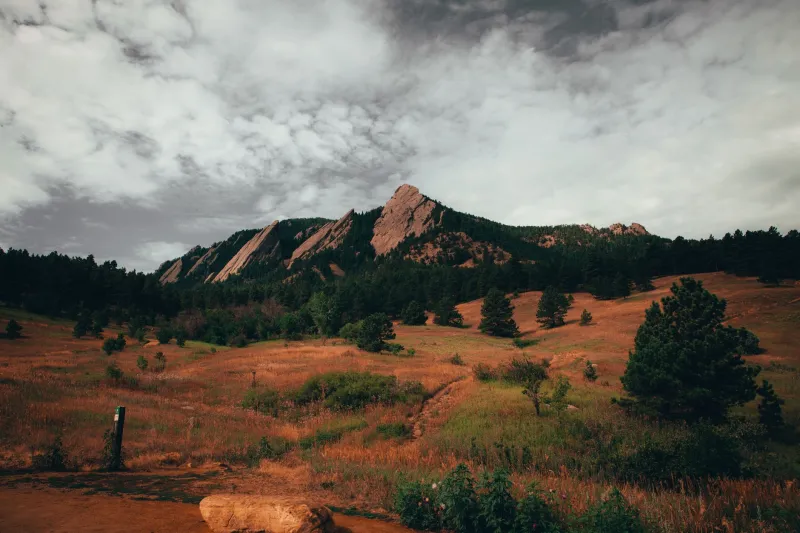
The Flatirons aren't just a pretty backdrop. They're a physical wall that redirects airflow, creates wind shadows, and channels cold air down into specific drainages. The result is that neighborhoods along the base of the mountains can experience frost weeks earlier than neighborhoods a mile to the east. Wind speeds along exposed ridgelines routinely double what you'd see in a sheltered valley just below.
Aspect: Which Way Does Your Yard Face?
One of the biggest factors most Boulder homeowners never think about is aspect—the direction your yard or slope faces. South-facing slopes in Colorado get hammered with direct sun, especially in winter when the angle is low. Soil on a south-facing slope can be ten to fifteen degrees warmer than a north-facing slope just a few hundred feet away, and it dries out far more quickly.
If your yard slopes toward the south and you plant a species that prefers consistent soil moisture—blue spruce, for example—you're setting yourself up for a slow struggle. That same tree planted on a north-facing lot across the street, where soil stays cooler and retains moisture longer, might thrive without much intervention at all.
Conversely, north-facing yards in Boulder can harbor late-season frost pockets that wreak havoc on species with early spring bud break. A tree that blooms beautifully in Denver might get its flowers killed by a late freeze every single year in your yard, depending on where cold air pools on your property.
Canyon Winds and the Flatiron Effect
Boulder gets wind. Anyone who's lived here for a full year knows this. But what's less obvious is how inconsistently that wind is distributed across the city.
Boulder Canyon, Eldorado Canyon, and the various drainages along the mountain front act like funnels, accelerating airflow and directing it into specific neighborhoods. Areas near the mouth of Boulder Canyon—particularly parts of Mapleton Hill and the neighborhoods just north of it—see sustained wind events that can stress trees through desiccation, physical branch damage, and soil erosion at the root zone.
Trees in these areas need to be wind-tolerant by nature. Ponderosa pine, Rocky Mountain juniper, and bur oak all have structural qualities that help them handle persistent wind loading. Softer-wooded species like silver maple or Siberian elm may grow quickly in these spots but are far more likely to suffer catastrophic branch failure during a Chinook event.
A few blocks away, tucked behind a ridgeline or a dense row of existing trees, a yard might be almost entirely sheltered from those same winds. That changes everything about what you can plant and where.
Elevation Changes Within the City
Boulder's elevation ranges from roughly 5,200 feet in the eastern parts of the city to well above 6,000 feet in the foothills neighborhoods. That 800-foot difference might not sound like much, but it corresponds to measurable differences in growing season length, UV intensity, and temperature swings.
Higher-elevation neighborhoods near Chautauqua or in the Knollwood area have shorter frost-free windows and higher UV exposure—a combination that can sunscald thin-barked trees and stress species that weren't selected with altitude in mind. At these elevations, sticking with trees that naturally grow in Colorado's montane zone isn't just a stylistic preference. It's a survival strategy.
Soil Drainage: The Hidden Variable
Boulder's soils are wildly inconsistent. You can have sandy, fast-draining soil on one side of a property and a thick clay layer just twenty feet away where water pools after every storm. Trees planted in poor-draining soil are at constant risk of root rot, oxygen deprivation, and fungal disease—even if you're watering appropriately.
Before you plant anything significant, it's worth doing a simple drainage test: dig a hole about twelve inches deep, fill it with water, and see how long it takes to drain. If it's still sitting there six hours later, you have a drainage problem that needs to be addressed before you put a tree in the ground.
Making Your Microclimate Work For You
The good news is that microclimates aren't just obstacles—they're opportunities. A sheltered south-facing corner of your yard might actually support species that would otherwise be marginal at Boulder's elevation. A consistently moist north-facing slope could be perfect for a paper birch grove that would wilt under full sun exposure elsewhere on your property.
The key is observation. Spend a full season paying attention to where frost lingers in spring, where the soil dries out fastest in summer, and where the wind hits hardest during fall storms. That information is worth more than any generic planting guide.
When in doubt, talking to a local arborist who knows Boulder's neighborhoods intimately is the fastest shortcut to getting it right. We've seen enough site-specific failures—and successes—to spot the microclimate patterns that aren't obvious until you've been paying attention for years.
Your neighbor's tree isn't thriving because they got lucky. It's thriving because, intentionally or not, it ended up in the right microclimate. The goal is to stop leaving that to chance.